
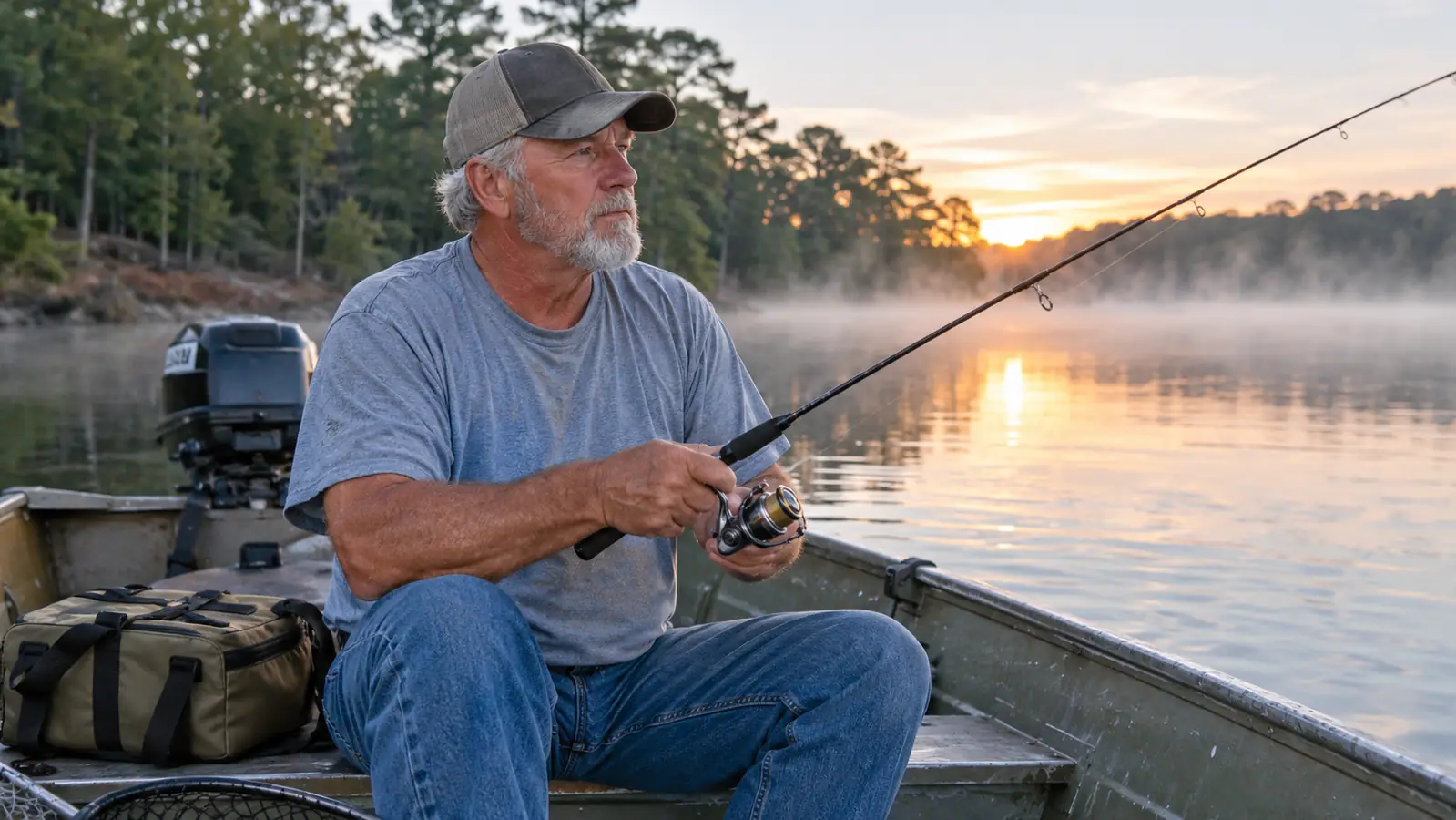
Short answer: I spool Berkley Trilene XL on the rods I use for ponds, creeks and the shallow end of Lake Eufaula, and I keep braid on one rod for thick grass and rocks. That is not fence-sitting. The two lines do different jobs, and the angler who tries to make one do both ends up respooling on the tailgate. I am 58, I fish out of a 14-foot aluminum jon boat, and I have been particular about tackle for about ten years now. The best line is the one that lets me cast where I am looking without a bird nest. Berkley Trilene XL has been that line more often than not.
Here is the short version. Trilene XL is a 6-pound monofilament, 330 yards on the spool, with a 0.009 inch diameter. It casts easy, ties simple, and stretches enough to forgive a bass that surges at the boat. Braid is thinner for its strength, has almost no stretch, and cuts through vegetation. If you fish clean water and want a limp line that behaves, the Berkley is the easier answer. If you fish matted grass, laydowns or a rocky creek, braid earns its spot. I will walk through where each one wins, because I have cussed both.
| Berkley Trilene XL (6 lb) | 20 lb braid | |
|---|---|---|
| Best for ponds and open water | Limp, easy casting with light lures | Works, but stiffer and more wind knots |
| Best for matted grass and laydowns | 6-pound mono will not cut it | Cuts through vegetation and hauls fish out |
| Forgiving stretch on a hookset | Gives enough to keep treble hooks pinned | Almost none, direct and sometimes too direct |
| Sensitivity | Muted by stretch | Feel the bait ticking bottom |
| Abrasion resistance | Scuffs in rocks and wood | Holds up better around shell and rock |
| Line memory | Coils after a few weeks on the spool | No memory to speak of |
| Knot simplicity | Improved clinch and Palomar both work | Needs Palomar or a leader knot, clinch can slip |
| Casting light lures | Handles a small crankbait or beetle spin | Too stiff for the lightest stuff |
| Clear-water visibility | Less visible to pressured fish | More visible, leader often needed |
| Longevity on the reel | Respool once or twice a season | One spool can last a couple seasons |
| Best for crappie and bream | 6-pound is right at home | Overkill for panfish |
| Best for frog fishing | Not the tool | The tool |
Where Berkley Trilene XL Wins
The first thing I notice with Trilene XL is how little fuss it makes. On a 6-foot spinning rod, a 1/16 ounce jig and a small cork, the line peels off the spool and goes where I point it. The 0.009 inch diameter is thin enough for a pond bass but still has some body, so it does not blow around in the wind like a spider web. Berkley lists 6-pound breaking strength and optimal wet strength, and I have found that wet strength claim to be the useful part. A line that weakens after an hour in the water is a line I do not trust. This one keeps its manners.
The stretch is the other reason I keep it. Mono gets knocked for stretch, and in deep water or heavy cover that knock is fair. But for a Texas-rigged worm around scattered wood, or a small crankbait with treble hooks, that give is what keeps a fish pinned. I have watched a bass make a run at the boat and the rod load up instead of the hook tearing out. The same give helps with bream and crappie, where a 6-pound line and a light rod make a two-pound fish feel like a good time. I spool 330 yards and it lasts me through a couple of trips before I trim the last few feet.
Knots are where Trilene XL earns its keep for me. An improved clinch knot, pulled down with spit, works every time. A Palomar works too. I can tie either one on a rocking boat with cold hands, and that matters more than any lab number. Braid is not hard to knot, but it is less forgiving of a sloppy clinch, and a slipped knot costs you the only bite of the afternoon. The Berkley line lets me keep it simple.
Where Braid Wins
Braid wins outright in cover. When I fish the grass mats on Eufaula, a 20-pound braid will saw through stems that would turn a 6-pound mono into a curly mess. The lack of stretch means a hookset goes straight to the fish instead of stretching eight feet of line first. I can feel a bait ticking a stump or a shell bed in a way mono mutes. If you fish a frog, a swim jig or a Texas rig in matted vegetation, braid is not a luxury. It is the difference between getting a fish out and leaving a hook in the salad.
Braid also lasts. A spool can stay on a reel for a couple of seasons if you trim the worn end and do not nick it on rock. It has no memory, so it does not come off the reel in coils on a cold morning. Those are real advantages, and I will not pretend otherwise. Where it loses is in the small stuff. It is more visible in clear water, so I end up tying a mono or fluorocarbon leader. It is stiffer with light lures. It wind-knots if you are careless. And it does not stretch, which is great in grass and less great when a fish surges at the net with a treble lure in its mouth.
The line I keep on the pond rods
Berkley Trilene XL in 6-pound, 330 yards, is the spool I reach for when I want easy casting and a knot I can trust. Check today's price on Amazon and spool it before your next trip.
Amazon Check Today's Price on Amazon →A Morning With Earl and Two Different Rods
My brother-in-law Earl came along on a Saturday last fall. He had a baitcaster with 20-pound braid and a frog, and I had a spinning rod with Trilene XL and a weightless worm. We put in at a ramp on the Chattahoochee side and worked a bank with a mix of open water and grass. Earl caught the first fish out of a mat, and I could hear the braid ripping through the stems. I caught mine on a point where the grass thinned out, and the mono let the worm fall slow and natural. Neither of us out-fished the other that morning. That is the point.
What I noticed was the retying. Earl had a wind knot after a missed cast into a headwind, and picking it out took him ten minutes. I had a backlash on a bad cast, but a 6-pound mono backlash is usually a pull and a prayer, not a surgery. I also noticed that when Earl hung a fish in the grass, he got it out. When I hung one near a laydown, I had to be careful with the 6-pound. That is the trade. Braid gives you muscle and takes away some forgiveness. Mono gives you forgiveness and asks you to stay out of the thick stuff.
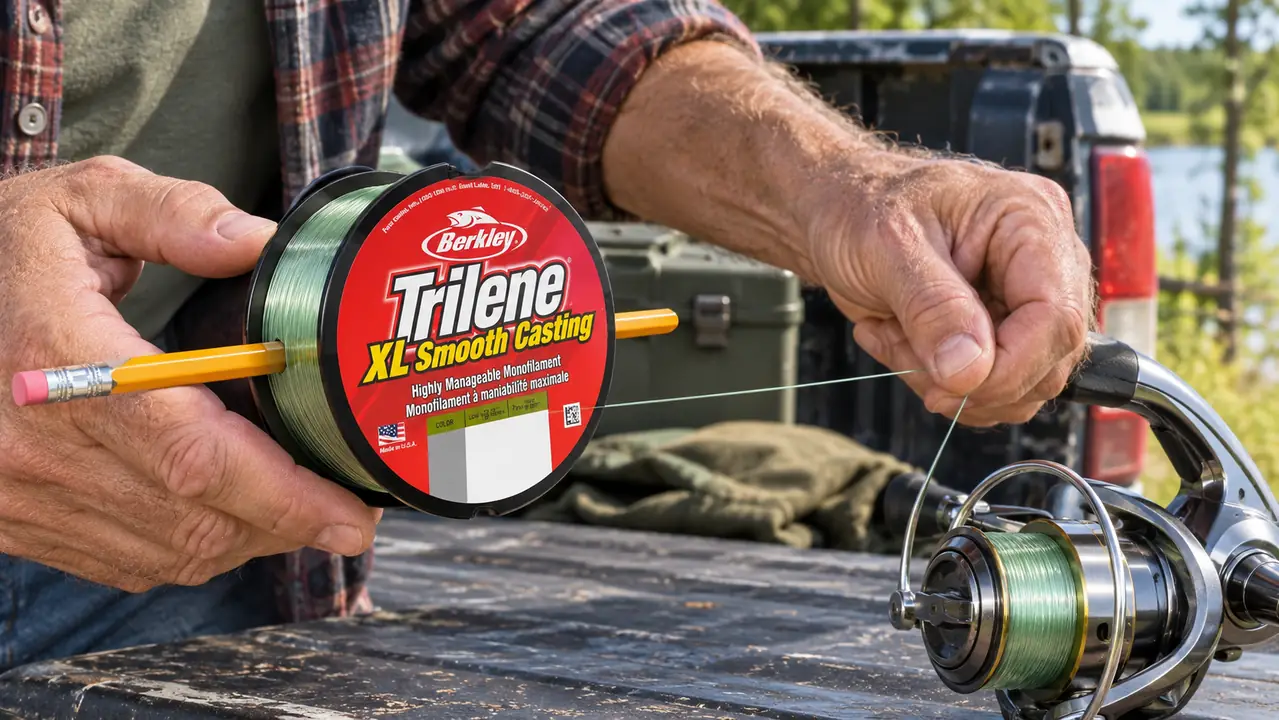
We both spooled up from bulk spools on the tailgate. I use a pencil through the spool and a wet rag to keep tension. Trilene XL goes on smooth if you keep tension, and it will twist if you do not. Earl's braid goes on tighter and digs into itself if he spools it loose. Neither line is foolproof. Both reward a little patience at the truck.
The Knot Problem Nobody Talks About
Braid has a reputation for being hard to knot. That is half true. A Palomar is easy and reliable. A double uni to a leader is not hard once you have tied it a hundred times. But a standard improved clinch with braid will slip, and it will slip on the fish you wanted. Mono is more forgiving of a knot that is not perfect. Trilene XL in 6-pound will hold with an improved clinch, a Palomar or a uni. That is not a small thing when the light is fading and your fingers are stiff.
The other knot issue is the leader. In clear water I want a mono or fluorocarbon leader on braid, which means another knot, another chance to fail, and another thing to check. With straight Trilene XL, there is no leader knot. The line goes from spool to hook. Fewer knots means fewer failures, and on a farm pond where a big bass might be the only one I hook all evening, I like fewer failures.
Line Memory, Spool Size and the Offseason
Monofilament has memory. Leave Trilene XL on a reel in the shed through a cold snap and it will come off in coils. I deal with it by stretching the first thirty feet against a fence post, or by spooling fresh line. The 330-yard spool is enough to fill a spinning reel and have plenty left for a respool. I usually change the top forty yards once the line gets scuffed, and I do a full respool at the start of the spring. That is not a complaint. It is the cost of doing business with mono.
Braid does not coil, but it can dig into the spool under pressure. I put a few yards of mono backing on a braid reel to stop the whole spool from slipping. That is a small chore, and it is one more reason I do not use braid on every rod. For the pond rods, Trilene XL goes straight on and I am done. For the grass rod, I take the extra step because the payoff in heavy cover is worth it.
There is also the matter of line twist. A spinning reel will put twist into any line if the drag slips or the bait spins. Mono shows it as coils and loops. Braid shows it as a soft spot and eventually a wind knot. I have had fewer line twist problems with Trilene XL when I close the bail by hand and check the spool. That is an old habit, not a line feature, but the line responds well to it.
The Abrasion Test I Did Not Enjoy
I fish a creek near home that has more rock than a man needs. One stretch is all chunk rock and old concrete, and a line that cannot take a scuff will fail you there. I took a rod with 6-pound Trilene XL through it and paid attention. The line held for a while, but after a few bumps and one fish that ran me around a rock, I could feel a rough spot above the hook. I cut it off and retied. That is normal with mono. You check the last six feet, you retie, you go on.
Braid in that same creek is tougher. It does not fray the same way on a light nick, and it will take more contact before it gives up. But braid has its own failure mode. A bad nick can weaken it without the fuzzy warning mono gives you, and it can cut your hand if you grab it under load. I still use mono in that creek most days because I am throwing small lures and I want the stretch. If I were throwing a jig around the concrete culvert, I would want braid.
A Word on Line Size
Trilene XL comes in break strengths from 2 pounds to 30, but the 6-pound spool is the one I use most. It is light enough for crappie and bream, and heavy enough for a pond bass if I play it right. The 0.009 inch diameter is a big part of why it casts so well. If I go up to 10 or 12 pound for bigger fish, I lose some of that easy casting and I gain abrasion resistance. That is a fair trade, but it is a different tool.
Braid does not follow the same size chart. A 20-pound braid is thin, and that thinness is the reason it cuts grass and casts a frog a long way. It is also the reason a beginner can get a wind knot that ruins ten yards in one cast. I would not start a new angler on 20-pound braid unless he was set on fishing heavy cover. I would start him on 6-pound Trilene XL and let him learn to cast and tie knots first.
Who Should Buy Which
If you fish farm ponds, creeks and the open edges of a reservoir, and you throw small crankbaits, worms, beetle spins and live bait for bream and crappie, buy the Berkley Trilene XL in 6-pound. It is the line that will give you the fewest headaches while you learn. It casts easy, knots easy, and forgives a hookset that is a little early. It is also the line I hand to a guest or to Earl when he wants to fish a beetle spin and not think about his leader.
If you fish matted grass, laydowns, shell beds or a rocky creek, and you throw frogs, jigs or Texas rigs with heavy weights, buy braid. A 20-pound braid is a reasonable place to start for bass in cover, and it will outlast mono around abrasive stuff. You will need a Palomar knot and probably a leader for clear water. You will also need to accept the wind knots and the lack of stretch. If you do, braid will get fish out of places where 6-pound mono has no business being.
The honest answer for most anglers is both. One spinning rod with 6-pound Trilene XL for finesse and open water, one casting or spinning rod with 20-pound braid for cover. That is what is in my boat. I keep a spare spool of Berkley in the truck, a pair of nippers and a rag. Tater rides along and sleeps on the bank while I mess with tackle. The system is not complicated. It just requires you to match the line to the water instead of asking one line to be everything.
Spool the pond rod with a line that behaves
Berkley Trilene XL, 6-pound, 330 yards. Easy casting, simple knots, and enough stretch to keep a good fish hooked. Check today's price on Amazon before you head to the ramp.
Amazon Check Today's Price on Amazon →