

Four pairs of fishing pliers have come and gone off my belt in the last ten years. One pair rusted shut inside a season. Another cut braid so poorly I went back to biting the line like I was twelve years old. A third pair opened up in my pocket and pinched me somewhere I will not describe at the supper table. So when a friend handed me a pair of Piscifun pliers last spring and told me to keep them, I did not treat it as a gift. I treated it as a test.
That was a year ago and they are still on the same belt loop. The Piscifun Saltwater Fishing Pliers are aluminum, spring loaded, and the listing puts them at 3.6 ounces, which is light enough that I forget I am wearing them until a fish needs unhooking. I fish farm ponds and the reservoirs of the Chattahoochee valley, Lake Eufaula and Lake Seminole mostly, chasing largemouth, crappie, bream and catfish from the bank or from a 14-foot aluminum jon boat that has seen better decades. These pliers have been rained on, dropped in red clay mud, left in the boat overnight in July, and asked to do a few things pliers were never designed for. Here is what a year actually told me.
The Quick Verdict
Light, spring loaded, and the tungsten carbide cutters still go through twenty-pound braid in one squeeze after a year of pond water and red clay. The nylon sheath is the weak link, and these are not heavy-duty pliers.
Amazon Check Today's Price →The pair I stopped loaning out, and why
Spring-loaded jaws that open on their own, replaceable tungsten carbide cutters, 3.6 ounces on the belt. Mine have been wet for a year and still cut clean.
Amazon Check Today's Price on Amazon →How I've Used It
Most of my fishing is bank fishing or close-in work from the jon boat, which means I am usually kneeling in mud or sitting on an overturned bucket with a rod in one hand. The pliers come off my belt maybe thirty times in a four-hour trip. Unhooking a bream that swallowed a cricket whole. Cutting braid after a snag eats a lure. Opening a split ring to swap a treble on a crankbait. Holding a hook steady while I tie a palomar with the other hand. None of that is glamorous work, and all of it is work I used to do badly with my teeth and a pair of rusty needle noses rattling around in the truck box.
Two things made me keep carrying them past the first month. The first is the weight. At 3.6 ounces they do not drag my shorts down the way a heavier pair does, and I say that as a man who has watched a good tool slide out of a loose pocket and disappear into the water. The second is that the jaws stay open on their own, so I can pull them off my belt, get a hook out of a fish, and put them back without ever setting down the rod or taking my eyes off what I am doing. On the bank, with a catfish flopping and a fifty-pound Catahoula mix named Tater trying to help, that matters more than any line on a spec sheet.
The middle of last summer my brother-in-law Earl borrowed them to deal with a backlash that had turned into a bird nest of braid. He handed them back, worked his jaw a second, and said he needed a pair of those. Earl does not say that about much of anything, and he says it about nothing that costs money. Take that for whatever it is worth. It happened on a hot Saturday with nobody selling anything and no camera running, which is the only kind of endorsement I put much stock in anymore.
Why the Spring-Loaded Jaws Matter More Than They Sound
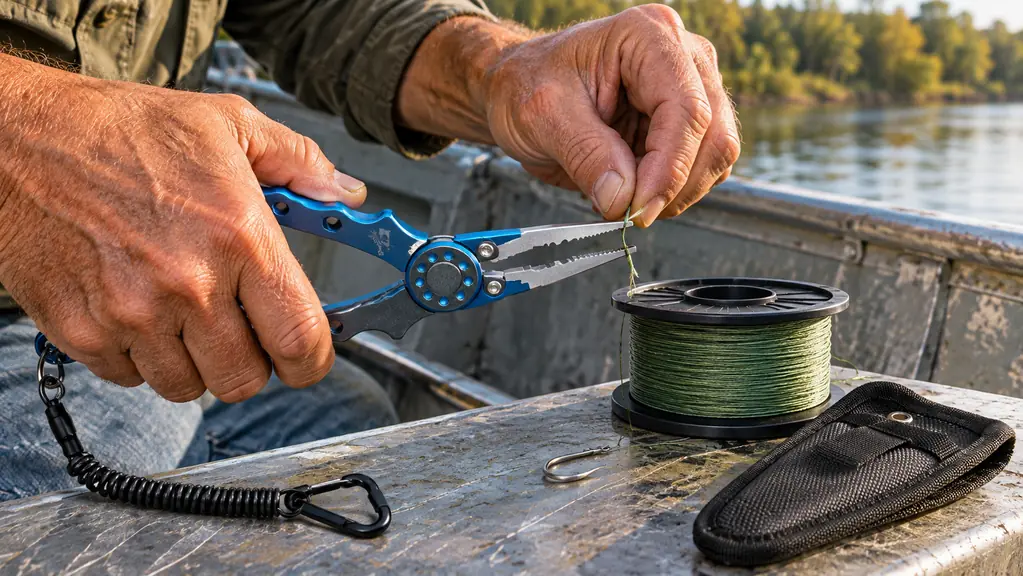
A fishing plier lives or dies on whether you can run it with one hand. When you have a fish in one hand and a plier in the other, and the fish is not cooperating, a pair that closes itself and has to be pried back open will cost you a hook, a fish, or a knuckle. The Piscifun pliers are spring loaded, and the spring on my pair is still doing its job a year in. The jaws sit open at rest and open themselves again after every squeeze, which sounds like a small thing until you go back to a pair that does not.
The handles are CNC machined aluminum, and they are shaped so my hand settles into them without hunting around. I wear a large glove and they do not feel small in it. They also do not feel like a precision instrument that will come apart if I drop them on the boat bench, which I have, several times, usually with a fish still attached to the other end of the line. Aluminum is not magic and it will pit if you put it away wet and forget about it. But it does not rust through the way the cheap steel pair I owned years ago did. I rinse mine in the pond, dry them on my shirttail, and hang them up, and they still open and close like they did in March.
The Cutters Do the Real Work
The tungsten carbide cutters are the part I would pay for on their own. Braid is miserable stuff to cut with a dull edge. It flattens, it slides up into the jaws, it frays into a little brush on the end, and eventually you are biting it, which is a fine way to chip a tooth on twenty-pound test. The cutters on these go through braid in one clean squeeze. I have cut hundreds of tags with mine, mostly twenty-pound braid and some twelve-pound mono for crappie rigs, and I have not once had to squeeze twice or turn the line around and try again.
The other thing the listing mentions, and I have since confirmed with my own hands, is that the cutters are replaceable. Every cutting edge dulls eventually. Most pliers you throw away when that day comes, and you buy another pair, and the handles and the spring go in the trash with the dull blade. This one you can keep. That is the difference between a tool and a disposable, and it is the single reason I would buy these again instead of trying something new.
The nose carries a split ring point as well, which I use more than I expected. Swapping a treble on a crankbait used to mean digging a separate tool out of the box while the boat drifted into the bank. Now it is one tool and about eight seconds. It is not the reason to buy the pliers, but it is the reason I stopped carrying two things on my belt, and my shorts appreciate the reduction in weight.
A year of pond water, red clay and July heat, and mine still go through twenty-pound braid in one squeeze. That is the whole test as far as I am concerned.
A Year of Pond Water, Red Clay and One Bad Afternoon
A year is not a lifetime, but it is long enough to show a pattern. Mine have been dunked in Eufaula, dragged through the red clay on a farm pond outside Dothan, left in the boat overnight in July heat, and rained on more times than I can count. What I look for after a year of that is slop. Jaws that no longer meet flat. A spring that sags and lets the handles flop. A handle that wobbles on its pin. I have none of that. The jaws still close flush along their length. The spring still snaps them open. Nothing rattles when I shake them next to my ear.
The afternoon I did not plan was the real test. I knocked them off the bench into the bottom of the jon boat while unhooking a bass, and then, because I was watching the bass and not my feet, I stepped on them. A pair with thin plating or a hollow handle would have given up right there and I would have been cutting line with a rusty pair of side cutters for the rest of the season. Mine came out of it with a scratch on one handle and nothing else. That scratch is now the only thing that tells them apart from a new pair, which is a better record than I can claim for most of the tackle in that boat.
What I cannot tell you yet is how they will look after five years. The aluminum will eventually show its age, and any cutting edge will dull no matter what it is made of. But the design is built so that the dull part can be swapped and the rest can keep going, and that is the most I ask of any tool I carry to the water. I will report back when something actually fails. So far the only thing that has failed is the sheath, and I will get to that.
Where the Piscifun Pliers Fall Short
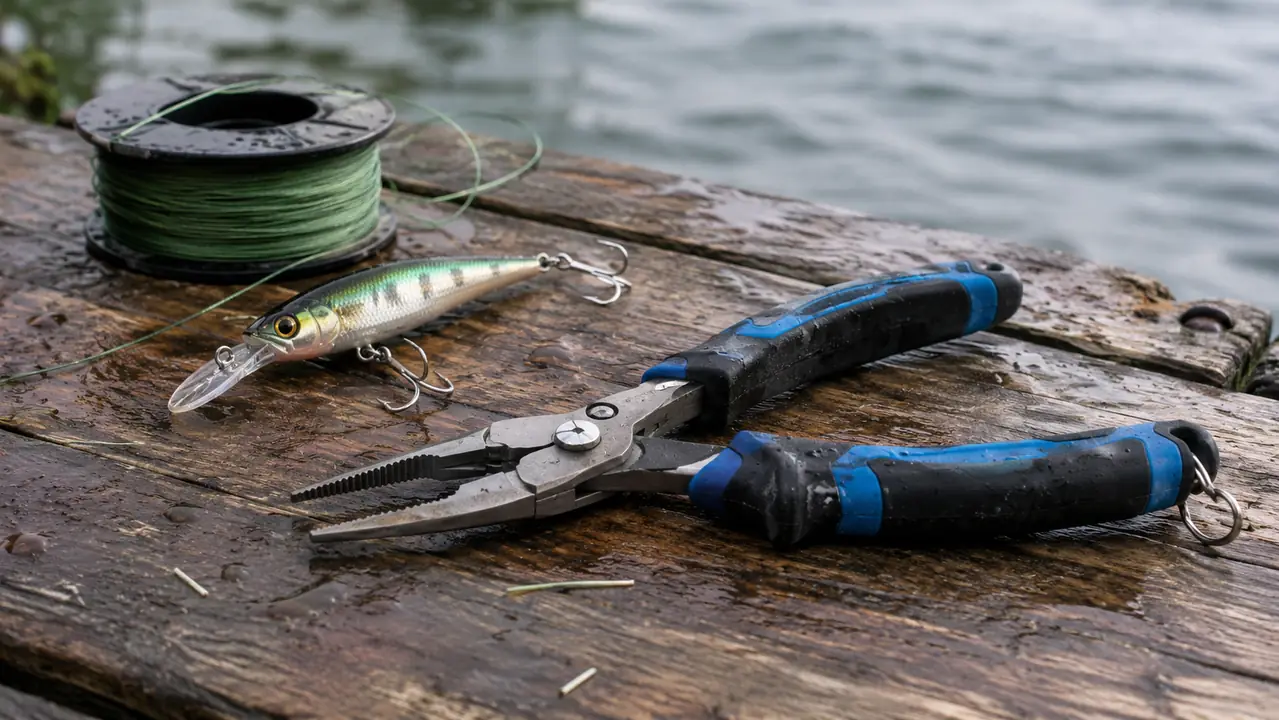
Two honest complaints. First, the sheath. It is nylon, it does the job, and it is the part of this setup that feels like an afterthought. After a year of daily carry mine has gone soft and stretched and does not hold the pliers as snug as it did in the spring. It is not going to fail on you tomorrow, but it is the first thing I expect to replace, and if you are the sort who buys a good tool and then buys a decent sheath, go ahead and plan for that now.
Second, these are light pliers and they behave like light pliers. If you are working heavy wire hooks, thick single-strand, or big split rings on big swimbaits, you want a heavier tool in the box alongside these, and no lightweight aluminum plier changes that. The split ring point is handy on a crankbait treble. It is not what I would reach for on a heavy ring with cold hands. I would rather tell you that than have you find out on the water. Also, and this is on me and not on Piscifun, aluminum will pit if you put it away wet every trip. Rinse it and dry it and it will outlast your patience.
What I Liked
- Spring keeps the jaws open, so one hand can do the whole job
- Tungsten carbide cutters cut braid in one clean squeeze and are replaceable
- 3.6 ounces, light enough to stay on the belt all day without noticing
- CNC aluminum handles have taken a year of drops and stepping on without wobble or rattle
Where It Falls Short
- The nylon sheath goes soft and stretched and is the first thing you will replace
- Not a heavy-duty tool; thick wire and big split rings want something bigger
- Aluminum will pit if you store it wet, so it needs a rinse and a dry
Who This Is For
This is for the pond and reservoir angler who ties braid, swaps trebles, and unhooks fish all day from the bank or a small boat. If your pliers live on your belt and come off thirty times a trip, the spring and the weight are worth more to you than any other feature on the tool. It suits a one-handed fisherman, which is to say almost all of us, and it suits somebody who is tired of buying a new pair every spring because the old one quit cutting. Freshwater, warm water, red clay, jon boat, four hours on a Saturday. That is the job these were built for and that is the job they have done for me.
Who Should Skip It
If you fish saltwater offshore and lean on a pair of pliers to open heavy hooks and cut thick leader all day, buy a heavier tool and do not ask a 3.6-ounce pair to be something it is not. If you fish four or five times a year and keep your pliers in a boat compartment, a cheap pair will honestly get you by, and I would rather say so than sell you something you do not need. And if you are the person who loses things, understand that light pliers are easy to set down and forget. Mine have stayed put for a year, but I check my belt now, and so should you.
A year on my belt, and I am still not shopping for another pair
Spring-loaded jaws, replaceable tungsten carbide cutters, 3.6 ounces. Mine have cut braid, opened split rings, and survived being stepped on in the bottom of a jon boat.
Amazon Check Today's Price on Amazon →