
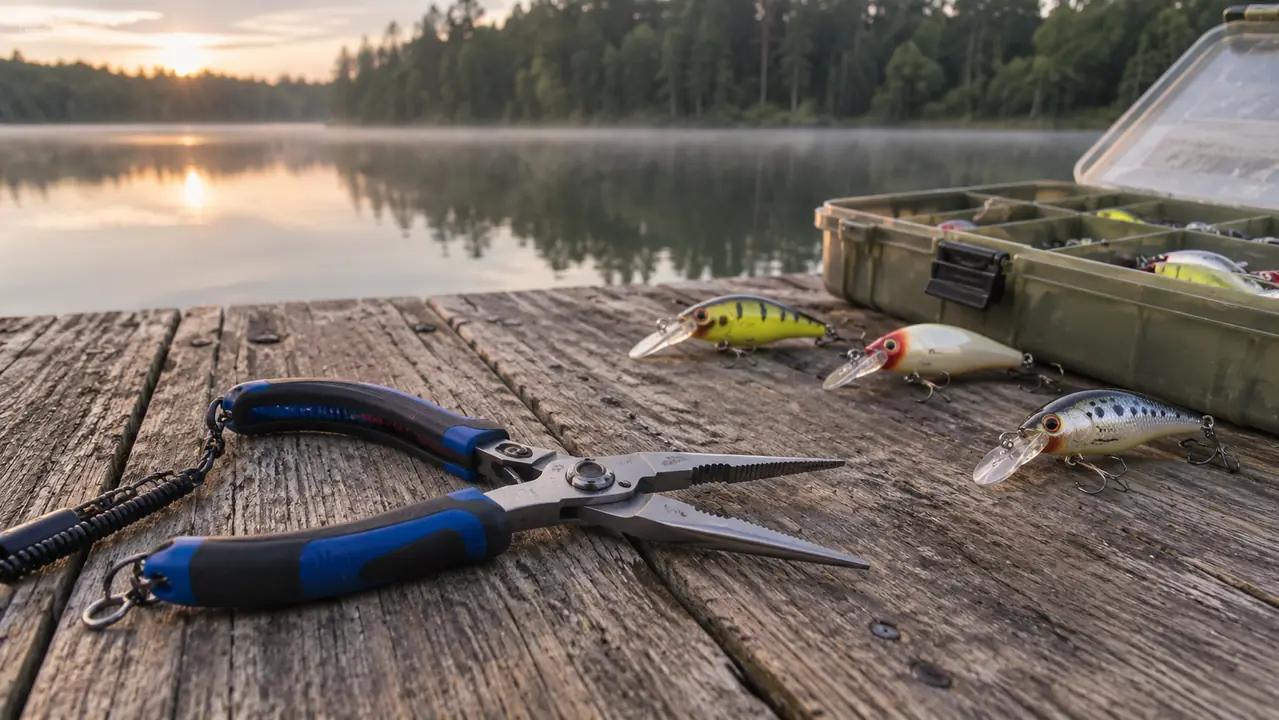
Nobody warns you that the worst part of cheap fishing pliers is not the rust. It is the moment you finally need them. Mine sat in the bottom of the boat box for two seasons, and the day a treble hook buried itself past the barb in the meat of my hand, the pivot was seized up so tight I had to open the jaws with my teeth. I am not proud of that. I am telling you because it is the kind of thing that turns a two minute fumble into a much longer afternoon than you had planned, and because I have since learned that the pivot is the only part that ever really matters.
The Piscifun Fishing Pliers are what I settled on after that. Aluminum handles, spring loaded jaws, tungsten carbide cutters, a split ring tip, and a nylon sheath for the belt. Not one thing on that list is exotic. What makes the pair worth writing about is which of those pieces held up under real use and which one I would change tomorrow if I could. That is what this is: an honest review of the parts the listing gets right, the parts it does not mention, and the one habit that decides whether yours lasts two seasons or ten.
The Quick Verdict
A light, spring loaded pair that opens one handed and cuts braid clean. The sheath and the finish are the compromises, not the cutters.
Amazon Check Today's Price →These Live on My Belt Now, Not in the Bottom of the Boat Box
Spring loaded jaws that stay open, tungsten carbide cutters that stay sharp, 3.6 ounces on the belt. The pair I reach for without looking down.
Amazon Check Today's Price on Amazon →What Nobody Tells You Before You Buy Pliers
The pivot is the whole ballgame. Every pair of pliers you have ever thrown away was thrown away because of the joint, not the jaws. Salt, grit off the bank, and whatever passes for lubricant in a bait shop all work their way into that pin, and once it stiffens up you are back to two hands and a bad attitude. Jaws that are still sharp do you no good if you cannot get them open before the fish quits flopping.
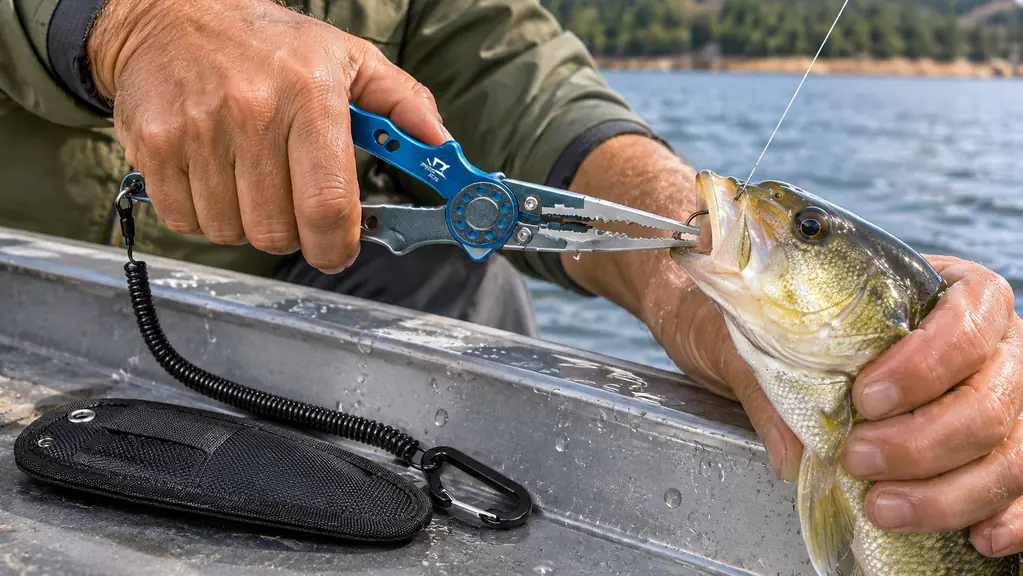
A spring loaded pair changes the way you fish, and I do not say that lightly. The spring holds the jaws open at rest, so you can slide them onto a hook eye with one hand while the other hand holds the fish. When you have a largemouth in one hand and a treble hook in the other, that is the difference between a fish released clean and a hook in your knuckle. It is a small mechanical advantage that pays off every single trip.
The second thing nobody tells you is that the cutters matter more than the handles. You can cut braid with a dull pair once, maybe twice, before it starts chewing instead of slicing. Chewed braid frays. Frayed braid is how a man loses the best fish of the morning on a hookset and spends the ride home wondering what he did wrong. Tungsten carbide is the material that stays sharp longest in grit and salt water, and it is the reason I stopped carrying the pair I had before.
How I've Used Them
Most of my fishing is farm ponds and the reservoirs out here in the Chattahoochee valley, Lake Eufaula and Lake Seminole mostly, chasing largemouth, crappie, bream and catfish. Some days it is the creek near the house with one rod and a small box and no plan at all. I fish from the bank about half the time, and the other half out of a 14 foot aluminum jon boat with a trolling motor clamped on the back and my dog Tater sitting in the shade watching the water like he is being paid to.
These pliers have been on my belt for a good while now. They have been rained on, dropped on the aluminum deck twice, dropped in wet grass, and left out overnight one time when I was tired and not paying attention. The spring still snaps them open. The cutters still slice 30 pound braid with one squeeze. That is the honest report after real use, not the report you write the afternoon the package shows up.
One morning last April on Eufaula sticks with me. Wind out of the southwest at a steady fifteen, the boat pushed sideways against a stump line, and I had six largemouth in the livewell before nine o'clock. The third one took a Texas rigged worm deep, past where I could see the hook point with the fish's mouth closed. I laid the rod down across the seat, got the pliers out of the sheath with one hand without looking, and had the hook backed out and the fish swimming again inside of ten seconds. I have done that same job with a stiff pair, and it took closer to a minute and a half, most of it spent fumbling and cussing.
They have backed hooks out of more bream and crappie than I could count, opened split rings on crankbaits in the boat, and cut braid in the dark when I could not see the tag end and had to go by feel. The one hand operation is what I notice most. On the bank with a catfish in the grass and a hook set deep in the corner of its mouth, you do not have a spare hand for a tool that fights you.
My brother in law Earl borrows them every time we fish together, which tells you something, because Earl has never borrowed anything in his life that he did not first criticize for ten minutes. He used them to open a split ring on a topwater plug in about the time it used to take him to find his reading glasses.
The Spring Is the Reason I Kept Them
If I had to point at one thing and say this is why the Piscifun pliers stay on my belt instead of in the box, it would be the spring. The jaws sit open at rest. You pick the tool up and it is already in position to work. That sounds like a small convenience until you have spent one full season with a pair that has to be pried apart with your thumb every single time you reach for it.
My first pair came out of a bait shop bargain bin and lasted about a season and a half. By the end of it I was holding the jaws open with my thumb knuckle while I lined the tip up on a hook eye, and I dropped more hooks than I care to admit because of it. It also taught me to check a joint before I trust a tool, which is a lesson I paid for in lost fish. The difference between that setup and a spring that does the work for you is the difference between a tool you tolerate and a tool you reach for without thinking.
One hand operation is the real benefit, and it is the benefit I would pay for again. Working a hook out of a fish means the fish is in one hand, the pliers in the other, and you are not using your teeth or your knee or your belt loop to hold the jaws open. That is the whole job on a muddy bank with a fish flopping and a hook buried where you cannot quite see it.
The weight helps here too. The listed weight is 3.6 ounces, and you feel that difference on a belt after five hours of walking a bank. Light enough that you forget they are there until you need them, which is the correct amount of attention for a tool to ask of you.
The Cutters, and My One Honest Complaint
The tungsten carbide cutters are the sharpest part of the whole package and the reason these replaced a pair that cost me a morning of frayed braid. They go through braid clean with one squeeze, no chewing, no white fuzzy tag end left behind. They are also replaceable, which matters more than folks give it credit for, because the cutters are the first thing to wear out and the last thing anybody thinks to check before a trip.
The retying is where I notice the cutters most. When you break off on a hookset you cut the tag, tie on a new hook, and cut again, and a dull pair turns that into a two minute fight with a frayed end you do not fully trust. I retied four times in one windy afternoon on Seminole, and the Piscifun cutters went through 30 pound braid in a single squeeze every time, no sawing, no digging around in my shirt pocket for a clipper. The small screw that holds the cutter in place has not backed out either, which is more than I can say for the pair before these.
Now the complaint, and it is not the cutters. It is the sheath and the finish. The nylon sheath is functional, and that is about the kindest thing I can say for it. It holds the pliers, it has a loop that goes over a belt, and it has not come apart. But it holds water and grit the way a cotton sock holds water, and after a wet morning you will want to dry both the pliers and the sheath or you will be looking at a stiff pivot by August.
That is the tradeoff I would flag to anybody standing in a store aisle. A spring loaded aluminum pair that lives in a nylon sheath needs a rinse and a drop of oil now and then. Do that and it will outlast the boat. Skip it for a whole season of grit and hard water and you will be the fella with the seized pivot again, and it will not be the pliers' fault that time.
Rust, Salt and the Maintenance Nobody Mentions
There is a whole conversation about aluminum versus stainless that I will not drag you through, except to say this: aluminum is light, and light is why the tool ends up on your belt instead of in the truck. The trade is that aluminum and a steel pivot do not love each other forever without a little attention. A rinse in fresh water at the end of the day and a drop of oil at the joint is maybe ninety seconds of your life.
I have gotten lazy about it exactly once, after a rainy two days on Eufaula where everything in the boat was wet including me. The pivot came up stiff the next morning. Not seized, but stiff. A rinse, a drop of oil, and ten minutes of opening and closing it while I drank coffee and the spring came right back. That told me what I needed to know about the tool and about my own habits.
The cutters have held up better than I expected through all of it. Braid is hard on cutters because it is abrasive, and grit off a muddy bank does not help. Mine still slice clean. If they ever stop, the replacement is a straightforward swap rather than a reason to buy a whole new tool, and that is a better deal than most tackle offers you.
Small Things That Turned Out to Matter
The split ring tip opens rings on crankbaits and topwater plugs without digging through the box for a separate tool. I used to keep a split ring tool in the boat and now I do not, because the nose of these does the job fine. One less loose object to lose in the grass, and one less thing rattling around when the boat is running.
The belt loop on the sheath is the part I use most and think about least. It slides over a two inch web belt and stays put when I bend over to lip a fish or reach down for the net, which is more than the clip on my old pair ever managed. I waded the creek near the house with it on back in the spring, water up past my knees, and I had to pat my hip once to make sure it was still there. That is what you want out of a sheath. No drama, no lost tool in the current.
The machined aluminum handles have not bent, chewed up, or worked loose at the pivot in the time I have carried them. The grip is comfortable enough that I have leaned on a stubborn hook without the handle edges digging into my palm. The ergonomic shape is not marketing talk on this one, it just does not fight your hand.
And the size. Closed up, they ride on a belt without snagging the rod or the net or the seat of the jon boat. That is a boring thing to praise a tool for, but a tool that gets in your way is a tool you leave in the truck, and a tool in the truck has never unhooked a single fish.
The spring still snaps them open. The cutters still slice 30 pound braid with one squeeze. That is the honest report after real use, not after unboxing.
What I Liked
- Spring loaded jaws sit open at rest, so you can work one handed with a fish in the other hand
- Tungsten carbide cutters slice braid clean and are replaceable when they finally wear
- 3.6 ounces on the belt, light enough to forget about until you need it
- Split ring tip means one less separate tool riding in the boat box
- Machined aluminum handles have not bent or worked loose at the pivot
Where It Falls Short
- The nylon sheath holds water and grit, so the pliers need drying and a drop of oil after a wet day
- It is not a neglect-proof tool. Skip the rinse for a season and the pivot stiffens
- The sheath is the weakest part of an otherwise solid package
Who This Is For
Bank and boat anglers fishing ponds, lakes and creeks for bass, crappie, bream and catfish. If you throw braid, if you fish crankbaits with split rings, and if you are tired of prying a stiff pair apart with your thumb every time you reach for it, this is the pair. It also suits the angler who wants one tool on the belt instead of three rolling around in the box.
It also suits the tinkerer, honestly. If you are the sort who already rinses and oils his reels at the end of a season, the maintenance on these is nothing you are not already doing, and you will get years out of them. The guys who get the most out of this tool are the ones who treat it like equipment instead of a disposable.
Who Should Skip It
If you fish the salt every week and you are not going to rinse and oil your tools, this is not the pair for you, and no aluminum plier riding in a nylon sheath is. Buy something you can abuse and accept the weight, or accept that you have to maintain what you own. Those are the two honest choices and there is no third one.
And if you fish a handful of times a year off a dock with a bobber and a worm, the pliers in your kitchen drawer will do everything you need. Nobody needs to buy a dedicated tool to unhook a bluegill twice a summer. Save the money for bait and a better rod and get to the water.
The Pair That Earned the Belt Loop Instead of the Boat Box
Spring loaded, tungsten carbide cutters, 3.6 ounces, and a split ring tip that replaces a tool you keep losing. Rinse it, oil it, and it keeps working.
Amazon Check Today's Price on Amazon →