
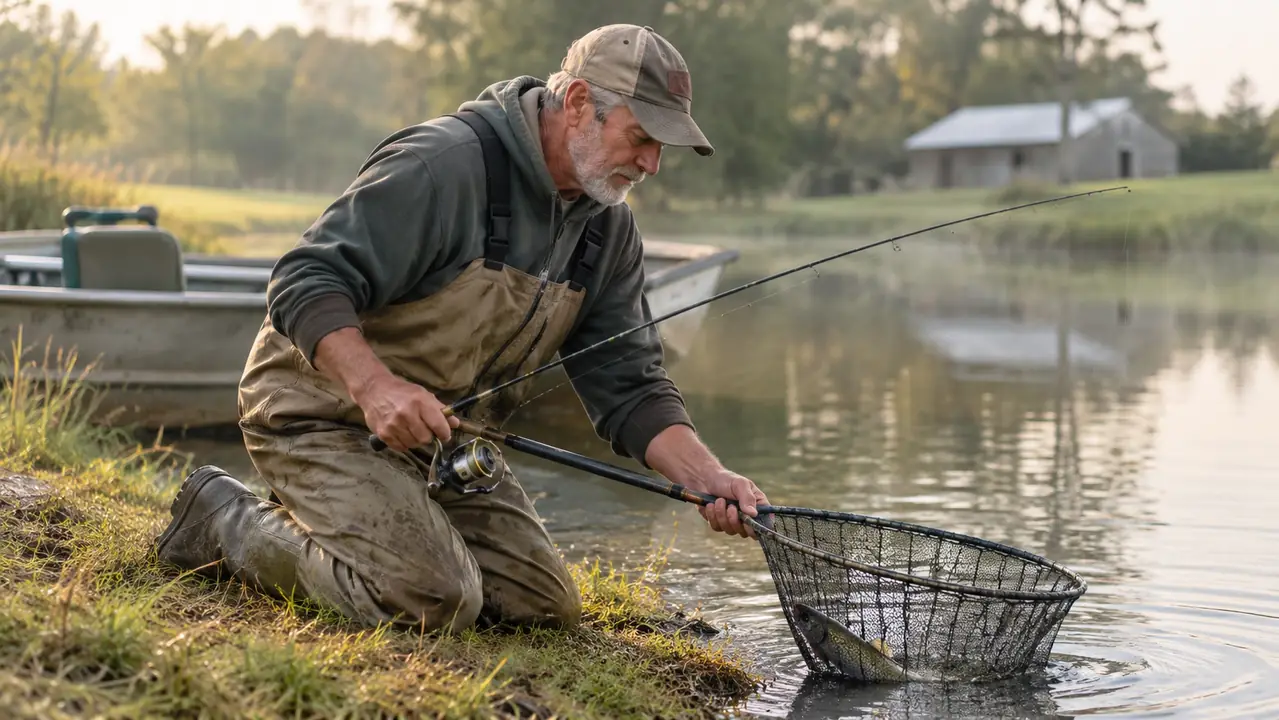
A bass with a 3/0 worm hook buried past the bend will teach you more about your own nerves than any sermon. I have stood in the gumbo mud on the north end of a farm pond with a four-pound largemouth thrashing in one hand and a hook down in the meat of its throat, and I have watched grown men cut the line and turn a fish loose because they did not have the right tool in their pocket. That fish swims off and everything looks fine. It is not fine. A hook left in a fish works toward the gills, and that fish is done. You did that because you were in a hurry.
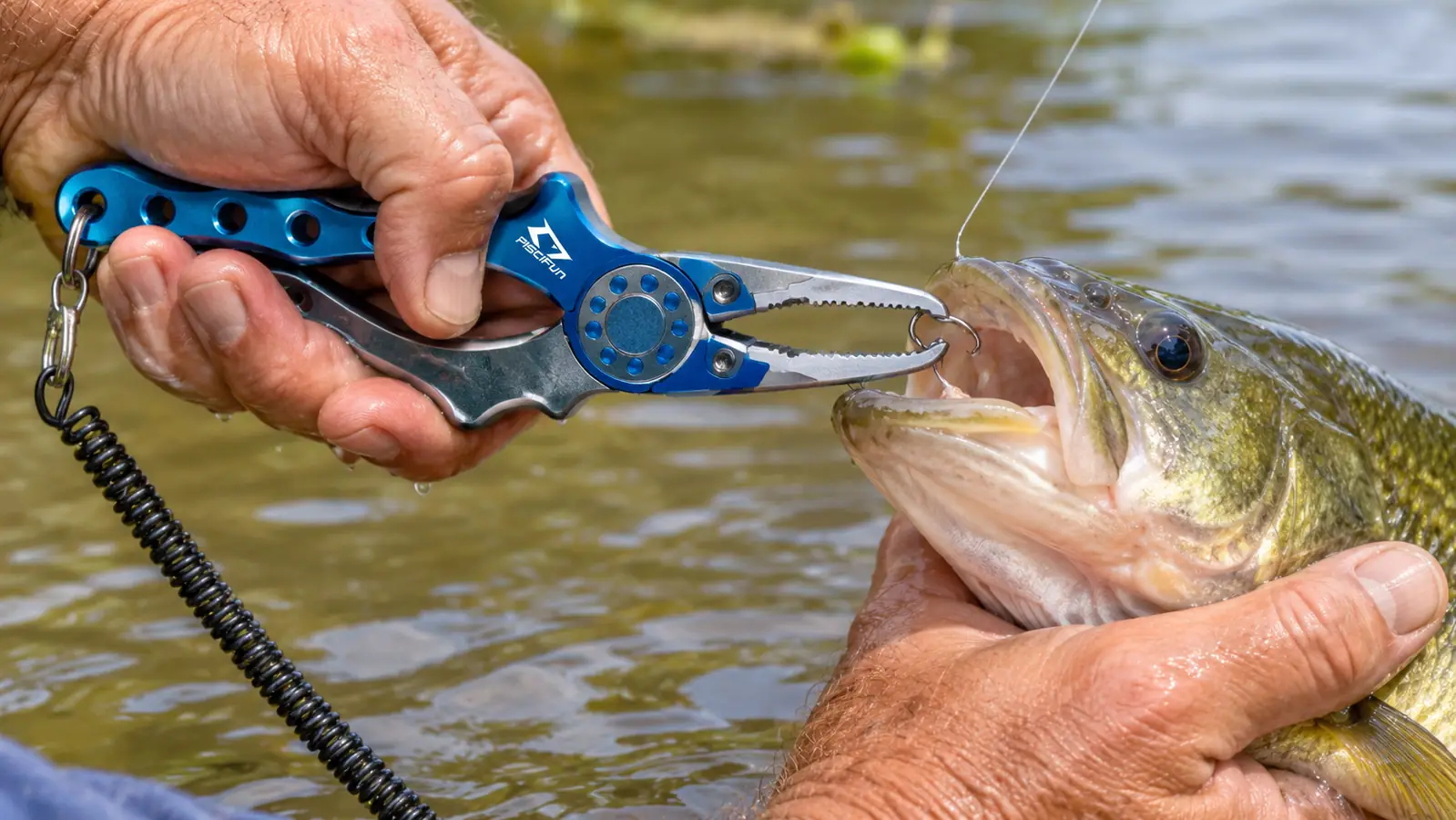
The fix is not complicated. It is a pair of pliers and an order of operations. I carry the Piscifun fishing pliers now, the aluminum ones with the spring in the handle, and the reason is plain: they open on their own, so I can run them one-handed while the other hand is holding a fish that does not care to be held. What follows is the sequence I run, in the order I run it, on the farm ponds around Dothan and on Eufaula when the bass push up shallow. None of it takes a minute once you have done it a dozen times.
One Tool, One Hand, Sixty Seconds. That Is the Whole Trick.
The Piscifun pliers spring open on their own so you can set the jaws one-handed, grip a hook shank without slipping, and cut hook steel with replaceable tungsten carbide cutters when the hook will not back out. It rides on your belt in a nylon sheath instead of buried at the bottom of a tackle box.
Amazon Check Today's Price on Amazon →Step 1: Wet Your Hands and Get the Fish Still
Dry hands strip the slime coat off a fish, and a stripped slime coat is an open door for fungus. So the first move is not the pliers. It is your hand in the water. Wet both hands, wet the grass or the rubber net, and then bring the fish up. On a bass I take the lower jaw with a thumb and never touch the gill plate, because a thumb in the gills will kill a fish quicker than the hook will. On a catfish or a big bream I keep the fish in the net and leave the net in the water while I work, and I do not lift a catfish by the jaw at all.
Next, kill the tension. Drop the rod tip, strip off a foot of line, and let the fish have slack. A tight line is a hook that keeps driving deeper every time the fish shakes its head. If the fish is flopping, hold it gently against your leg or lay it on wet grass for three seconds. Do not clamp it and do not squeeze it. A clamped fish tears itself up worse than the hook did, and a fish with a cracked rib does not swim off any better than one with a hook in it.
Check the other hooks before your fingers go anywhere near the mouth. A crankbait has two trebles hanging off it and the back one is usually buried in the net. I have put a rear treble in my own thumb three times in thirty years of fishing, and every one of those times I was looking at the front hook. Earl does the same thing about once a season, and he blames the fish.
Step 2: Read the Hook Before You Touch It
Now look. Not poke, look. You are answering one question: where is the point? If you can see the point and the barb sticking out of the meat, the hook came in point-first and it wants to leave the same way. If you can see the eye of the hook and the point is buried somewhere under the skin, the hook went all the way through and the exit wound is on the far side. Those two situations need opposite moves, and doing the wrong one turns a ten-second job into a fish with a torn mouth that will not feed for a week.
For the first case, point showing: you back it out the hole it made. For the second, point under the skin: you push the point up through a fresh spot, get hold of the point on the far side, and then back the shank out the way it came in. What you never do is lever the hook sideways against the jaw hinge. That is how jaws get broken, how hooks get straightened, and how a fish that would have been fine ends up floating belly up twenty yards down the bank.
On a treble it is the same read, just more of them. Find the one that is actually in the fish. The other two are decoration, and they will find your hand if you let them.
Step 3: Grip the Shank, Not the Bend and Not the Line
Grip the pliers on the shank, right up behind the eye, and close down. Not on the bend, because the bend is the part that flexes and a flexed hook is a dull hook. Not on the line, because gripping the line cuts it and now you have a loose hook in a fish with nothing to pull on. Shank, behind the eye, every time. That is the one spot on a hook that does not give.
This is where a spring-loaded pair earns its place. The Piscifun pliers sit open in your hand so you can slide the jaws over a shank without using your other hand to pry them apart, and your other hand is busy holding a fish. The CNC aluminum handles run about 3.6 ounces, which sounds like nothing until you have carried a heavy pair that pulled your waders down for a whole afternoon. The grip holds when it is wet, and it will be wet, and the jaws come down flat on a shank instead of skating off it.
Step 4: Follow the Curve, Slow and Steady
Push or pull in line with the shank, not sideways. The hook is a curve and the hole it made is a curve too, so the only path out is the path in. On a back-out, set the pliers and pull straight back with slow pressure, letting the barb open its own hole as it comes. If you feel it stop, stop. Back off half a turn, wiggle a little, and try again. A steady pull over three seconds beats a hard yank every single time, and it beats it by not tearing anything on the way out.
On a push-through, you are doing the same job from the other end. Push the point up through the skin at a fresh spot, keep the point above the surface, get the pliers on the point, and cut the barb off with the tungsten carbide cutters. Then the hook slides back out the way it went in, barbless and clean. The hole through the skin closes up in a couple of days. A hook dragged out through the barb instead leaves a slit that does not close, and that is the difference between a fish you catch again and one you do not.
A hook does not come out faster because you pulled harder. It comes out faster because you found the hole it already made.
Step 5: Cut Metal When the Hook Will Not Come
Some hooks are not coming out. A gut-hooked fish, a hook in the gill arch, a treble buried past the barb in a spot where you cannot get an angle on it. That is what the cutters are for. The tungsten carbide cutters on the Piscifun pliers will go through hook steel, not just line, and they are replaceable, which matters once you have cut a few dozen. Snip the hook at the bend and the two halves come out on their own with almost no pressure on the fish.
If a fish is hooked deep and bleeding, cutting the line close to the mouth and letting the hook work loose is a real option, and it is often better than digging around in a gill. Cut it long enough that the hook cannot turn and block the throat. And if the hook is in your own hand, in a finger, with the barb buried, cut the point off with the cutters and back the shank out the way it went in. That is a five-minute job at the tailgate instead of an afternoon in the emergency room in Dothan.
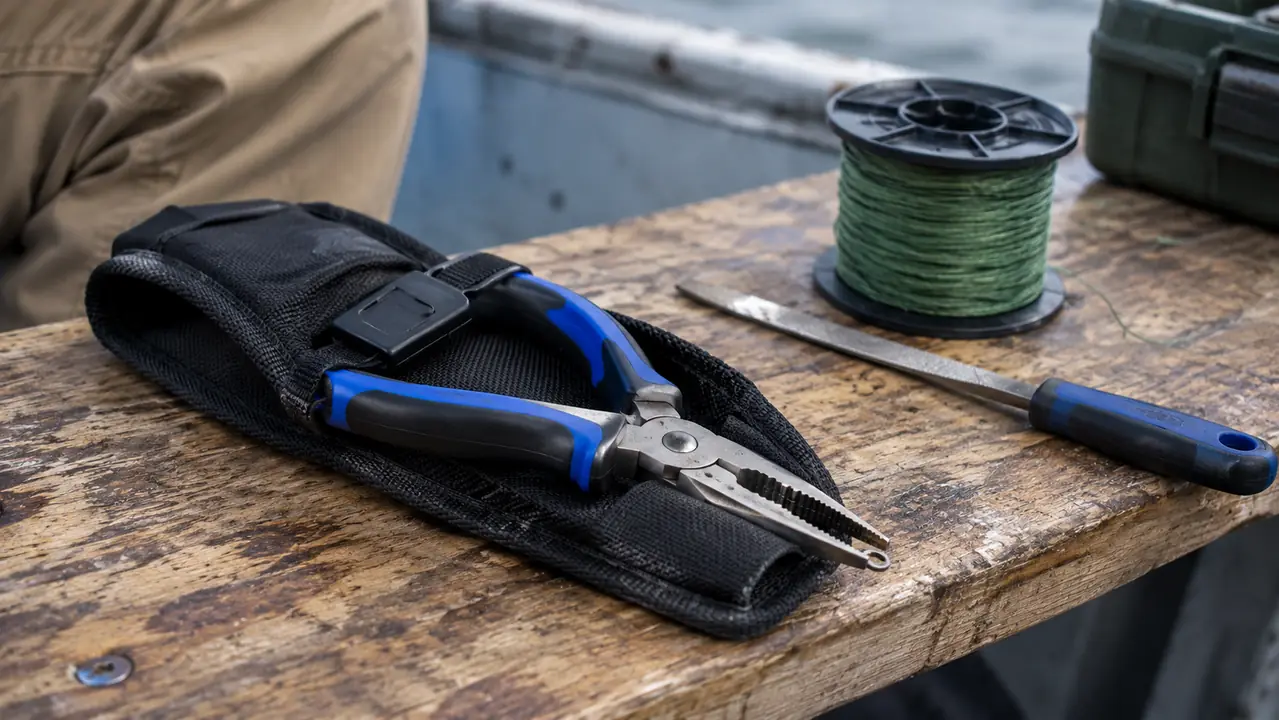
The cutters do the small jobs too. They trim 30-pound braid clean without fraying it, and the split ring feature opens a split ring so you can swap a worn treble for a fresh one without digging through the box for a second tool. Two jobs, one item on your belt, and neither one of them involves me kneeling in the mud looking for something I dropped.
What Else Helps
Carry the pliers on your belt, not in the box. The nylon sheath that comes with them is not fancy, but it keeps the jaws out of the grit in the bottom of the boat, and grit is what dulls a cutter faster than hook steel ever will. Keep a small hook file for points, a rag for your hands, and a bottle of water for flushing a bleeding gill. None of that costs much and all of it saves fish. On the jon boat the sheath hangs off the console, which is where my hand goes before my brain has caught up.
Fish barbless when you can. Crush the barb on your practice hooks and on the topwater baits where you are setting the hook hard anyway. Barbless hooks come out of a fish, and out of your hand, with almost no drama, and you will lose fewer fish than you think once you learn to keep the rod bent and the line tight. If you throw treble baits a lot, swap to single hooks. It is a five-minute change with the split ring, and it turns a two-minute unhooking job into a five-second one.
What I do not like: the sheath. The loop on the back of it stretched out after a season of hanging on a wet belt, and I replaced it with a short piece of paracord. The cutters also do not stay sharp forever when you use them on hook steel instead of line, which is exactly what I do with them. Replacements are easy to get and I keep a spare set in the truck. That is the whole complaint list, and neither item has cost me a fish.
The routine is the thing. Wet hands, slack line, read the hook, grip the shank, follow the curve, and cut metal when cutting is the right answer. Run it in that order a dozen times and it stops being an emergency and starts being a chore, which is exactly what you want it to be. A fish that goes back in the water clean is a fish you can catch again next spring, and that is the only scoreboard I keep.
The Ten Seconds After You Set the Hook Are the Ones That Matter
Keep the Piscifun pliers within reach and a deep hook stops being a panic. Spring-loaded jaws, a shank grip that holds, and cutters that go through hook steel, all on your belt where your hand already goes.
Amazon Check Today's Price on Amazon →