

My jon boat is fourteen feet of aluminum and there is not one spare inch in it. I fish Eufaula and Seminole and a creek near the house, mostly out of that boat or off the bank, and I have learned the hard way that anything loose in a small boat ends up either under my feet or over the side. Tackle is the worst of it. Tackle is small, it is numerous, and half of it comes in bags that split open the minute you set them down on a wet deck.
For years I carried one big tackle box. It weighed more than my trolling motor battery, and half of what was inside it I threw maybe twice a season. What fixed the problem was not a bigger box. It was a couple of shallow trays I could pull out one at a time, and the ones I have settled on are the KastKing Utility Tackle Boxes in the 3600 size. What follows is how I set them up for a jon boat, step by step, including the two things I got wrong before I got them right.
Two shallow trays beat one deep box in a boat this small
The KastKing 3600 trays run 10.8 by 7.25 by 1.65 inches and go from 3 compartments up to 18 with pre-cut dividers you set yourself.
Amazon Check Today's Price on Amazon →Why Loose Tackle Costs You Fish
A cluttered boat does not cost you fish in any dramatic way. It costs you in ten-second increments. You stop watching the line to dig for a worm. You set the rod down to pull a crankbait off a spinnerbait. You spend the last twenty minutes of good light sorting instead of casting. Multiply that across a season and it is not ten seconds anymore.
A jon boat makes all of it worse. There is no console to hang a bag on, no gunwale wide enough to line up six boxes, and no floor space you are not already using for your feet. Whatever you bring has to live in a footprint about the size of a shoebox lid, and it has to come out of there without you standing up and shifting your weight.
Step 1: Dump It All Out and Sort by How Often You Throw It
Empty everything out. Every bag, every pocket of every bag, the little compartment in the lid of the old box, the sandwich bag with the rusty hooks in it. Do it on a table in the garage, not in the boat. Then sort into three piles and be honest about which pile is which.
Pile one is what you throw on a normal trip. A couple of soft plastics in colors you actually believe in, a few hooks, a few weights, one or two crankbaits. Pile two is what you throw when the normal stuff quits working. Pile three is what you carry because you have always carried it. Most of pile three has been in the boat for three years and has never touched water.
Pile one goes in the tray that rides closest to your hand. Pile two goes in the second tray and stays in the boat. Pile three goes in a box in the truck and stays there. That last part is the whole trick. You are not throwing anything away, you are moving it twelve feet, which is close enough to go get and far enough that it stops taking up boat.
Be honest about the soft plastics in particular. I had a gallon bag of worms in colors I bought because they looked good in the package and never once tied on. They went to the truck box and I have not missed them. Plastics take up more room than anything else in a tray and they are the easiest thing in the world to over-carry.
Step 2: Set the Dividers With the Tray Empty
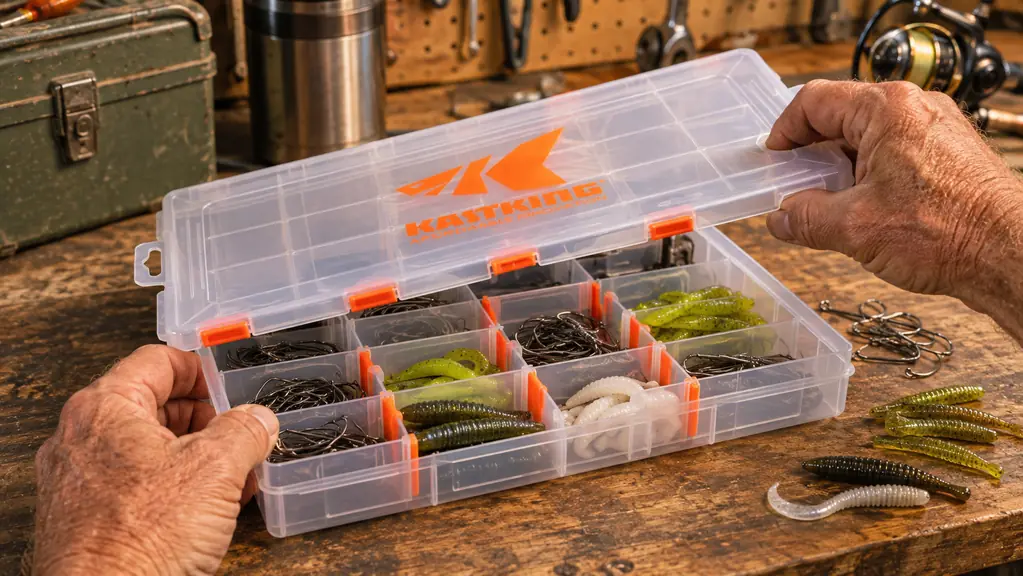
The KastKing trays come with pre-cut dividers, and the listing puts them anywhere from 3 compartments up to 18 depending on how you lay them in. The mistake I made the first time was loading lures and then trying to add dividers around them. That does not work. Set the dividers first, on a flat table, with nothing in the tray.
Think in terms of what a compartment has to hold. A row of soft plastics wants one long slot, not four short ones. Hooks and weights want small squares so they do not migrate into each other. Crankbaits want a slot wide enough that the hooks lie down instead of standing up and catching the lid. I run mine somewhere in the middle of the range, maybe ten compartments in the boat tray and closer to eighteen in the bank tray where the pieces are smaller.
Set it, then open and close the lid a time or two before you commit. If a divider is standing proud and the lid pushes it over, you will find out in the garage instead of on the water with a tray full of loose treble hooks.
Another thing I do is keep families together. All the hooks in one compartment, all the weights in another, plastics grouped by size rather than color. When you are rigging in a hurry you are thinking in categories, not in shades.
Step 3: Build One Boat Tray and One Bank Tray
The two-pack is the reason this works. One tray lives in the boat. The other lives in the truck or in a shoulder bag for bank fishing, and it holds a slightly different load. The boat tray carries shallow stuff you can fish fast. The bank tray carries the extras, because on the bank you are standing in one spot and you cannot walk back to the truck every eight minutes.
Keep an eye on the weight. The manufacturer rates these at 3 pounds max, and that is not a suggestion. A tray packed with lead and hard baits gets heavy in a hurry, and a heavy tray is a tray that dumps itself the first time you grab it one-handed off the bench.
I marked mine with a strip of tape on the lid, one mark for boat and two for truck. That sounds like something an old man would do, and I am an old man, so there it is. It saves taking the wrong tray out of the crate and finding out about it at the ramp.
The whole trick is not throwing anything away. It is moving it twelve feet, which is close enough to go get and far enough that it stops taking up boat.
Step 4: Give Each Tray a Fixed Home
A tray without a home slides. In a jon boat it slides toward the low corner, which is the corner with the bilge and the wet life jacket. Then you step on it in the dark. I have done this. My dog Tater has also done this, and he goes about fifty pounds, so the tray lost.
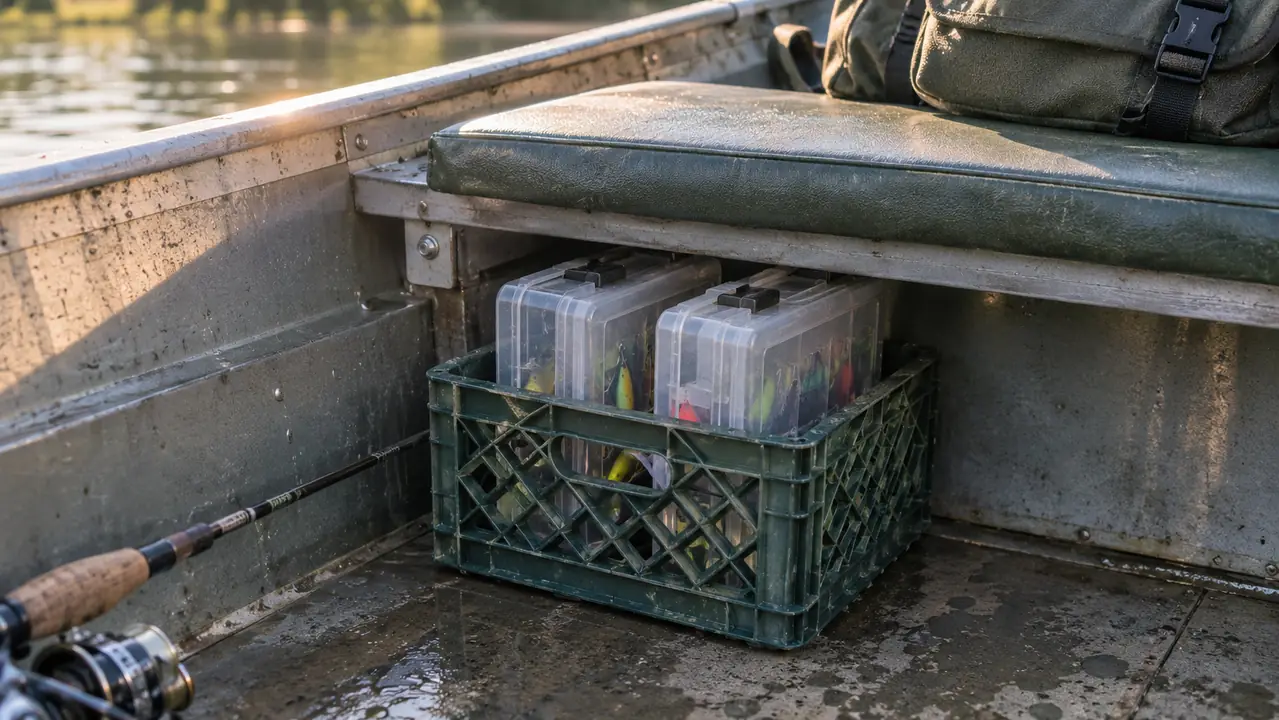
Mine ride under the bench seat in a milk crate I cut down to the right height. Nothing fancy. The crate keeps them upright and the bench keeps them out of the sun. If you do not have a crate, a bungee run across the top of the tray through a couple of existing holes in the bench works about as well.
Do not leave a tray on the front deck. It is the first place a hooked fish lands, it is the first place your foot lands when you stand to cast, and it is the first thing to go over the side when you catch a wake from a bass boat running too fast past a fourteen-foot hull.
Step 5: Rotate the Load Before Every Trip
Five minutes the night before, that is all it takes. Open the boat tray and look at what you did not touch last trip. If it is in the bottom of a compartment and it has been there three trips running, it moves to the truck box. This is the step that keeps the system working, because tackle creeps. It creeps back in one piece at a time, and in two months you are carrying a deep box again, just in two shallow pieces.
The other half of that five minutes is drain and dry. The trays are rated waterproof, but waterproof is about the box keeping water out, not about a wet worm drying itself off inside it. If I fished in the rain or took water over the bow, the trays come out and the lids come open in the garage overnight. A tray left closed with damp plastics in it in August will let you know about it in a way you will not enjoy.
Earl, my brother-in-law, does not do this step, and his boat smells like a bait shop by July. I have told him. He says it adds character.
Two Things I Got Wrong First
The first was trying to make one tray do everything. I had the boat tray loaded with the fast stuff and the just-in-case stuff together, and what happened is that the just-in-case stuff crowded out the fast stuff and then I could not find either. Two trays, two jobs. The boat tray is what you expect to throw. The truck tray is what you hope you do not need.
The second was leaving the trays in the boat between trips with the lids latched. That is fine in October. In an Alabama July it is not fine. Now the trays ride inside the truck between trips, on the floor behind the seat, and they only go in the boat the night before or the morning of. Takes thirty seconds and it has saved more plastics than any other habit I have picked up.
What Else Helps
The trays are the core of it, but the setup gets better with a few cheap additions. A small towel in the crate, so you have something to dry your hands on before you handle a reel or a phone. A hook file in its own compartment in the boat tray, because a dull hook loses fish and you are not walking back to the truck for a file.
A dry bag for anything that has to stay dry, which in an open aluminum boat is basically everything you care about. And a cheap pair of side cutters riding in the same compartment as your hooks, because the day you need them is not the day to go looking through three bags.
If you already own tackle bags, this is worth knowing. The 3600 and 3700 KastKing trays are built to be interchangeable with standard bags of the same size, so an old bag in the garage will take them without any fuss. I keep a soft bag in the truck with two trays in it and it has outlasted three bags I paid more for.
For bank fishing, the second tray plus a shoulder strap is the whole kit. You walk in with eight pounds instead of thirty, you set the bag down where you are standing, and you open one lid instead of unpacking a box on the gravel. That alone changed how long I stay on a pond bank in the heat.
Set up the boat once and stop digging for a worm every trip
Two 3600 trays, dividers you set yourself, built to drop into the standard bags you already own. Ten minutes in the garage and you are done for the season.
Amazon Check Today's Price on Amazon →